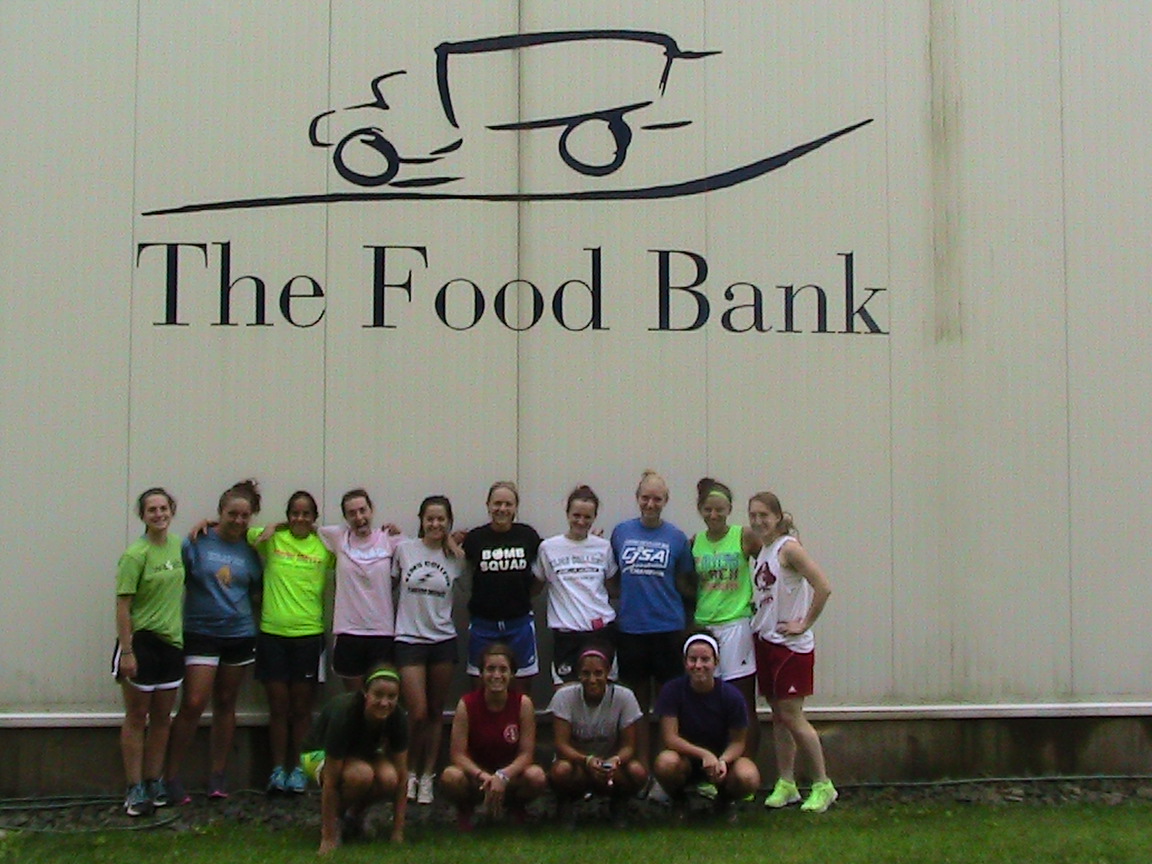
Women’s Soccer Kicks Off Season by Giving Back to the Community
HATFIELD, Mass. – The Elms College women's soccer team took time out of its busy preseason schedule and spent two days working behind the scenes at the Food Bank of Western Massachusetts located in Hatfield, Mass.
The Blazers started their time at the Food Bank by participating in an orientation about the function and process of the organization and were then put to work. Elms players and coaches worked in the Food Bank warehouses stacking boxes of donated items, sorting and packaging food (both frozen and dried), and sorting meat to be distributed to the over 250 food pantries throughout Western Massachusetts.
The Food Bank was incorporated as a 501(c)3 nonprofit organization in 1982 and in 1983, started its first Brown Bag: Food for Elders distribution in Hampshire County, and provided about 630,000 pounds of food to the community through the organization's small warehouse. In 1985, the Food Bank began a capital campaign to raise money to build a new, larger warehouse and in 1986, moved to a new warehouse in Hatfield (its current location).
In 1991, the Food Bank Farm in Hadley became the first community-supported agriculture (CSA) farm in the region with the primary mission to help feed those in need of food assistance. The farm provided produce to the Food Bank's network of member agencies and to a group of community shareholders.
In 2009, the Food Bank adopted a new strategic plan outlining its organizational goals for the next three years. The Food Bank concluded the Springfield Food Access Project as well as Target: Hunger Springfield in 2010, and Target: Hunger North Berkshires the following year. These projects were initiated as pilot programs, aimed at building capacity, handing the reigns to community members and serving as models for similar projects in other areas of the region.
In 2011, the Food Bank launched a Network Capacity Building program to support member agencies across its entire service area, using these successful projects as models.
For more information, visit http://www.foodbankwma.org/.


